 Myfxbook
 How to purchase and update products?
 FAQ – Frequently Asked Questions & Important Information at TopEAstore.com
 VPS
VPS DOWNLOADS
 My account

Obsidian Pivot Engine MT5 Unlimited


$20
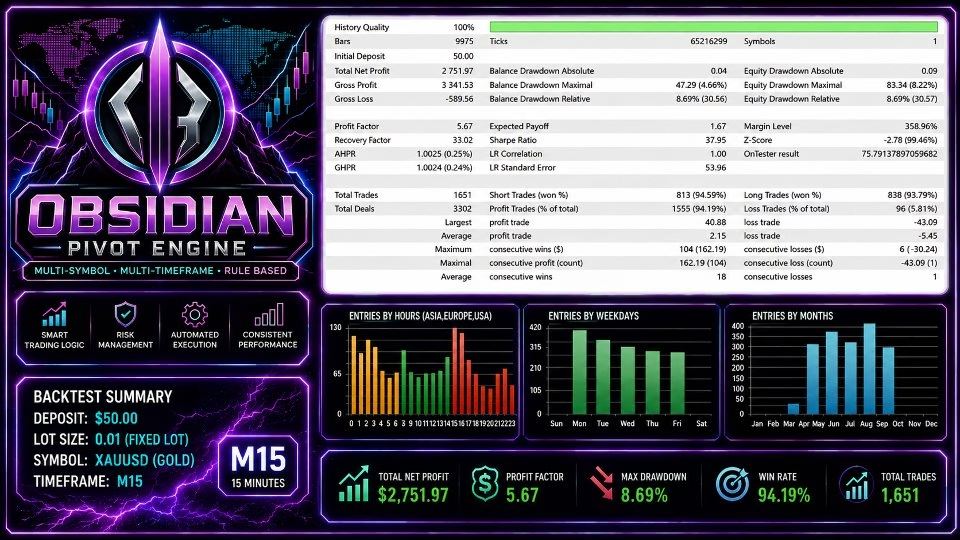
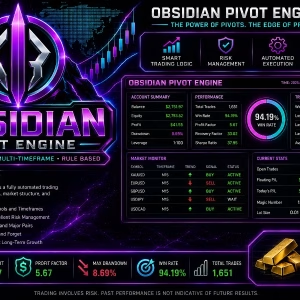
Obsidian Pivot Engine MT5 is a multi-timeframe breakout Expert Advisor primarily designed for XAUUSD M15, with additional support for BTCUSD and NASDAQ.
The EA analyzes market structure and trading levels across multiple timeframes and can place pending orders when potential breakout conditions are identified. It combines automated execution with configurable risk management, Stop Loss protection, trailing management, exposure limits, and order controls.
Receive your product instantly via email right after purchase.
All products sold on our website are full, unlimited-use versions.
Any new versions we receive will be automatically added to your account.
No hidden fees—what you see is what you pay.
Obsidian Pivot Engine MT5 – Multi-Timeframe Breakout Trading EA
Obsidian Pivot Engine MT5 is a professional Expert Advisor designed for MetaTrader 5, built around a level-based breakout trading approach with multi-timeframe market analysis.
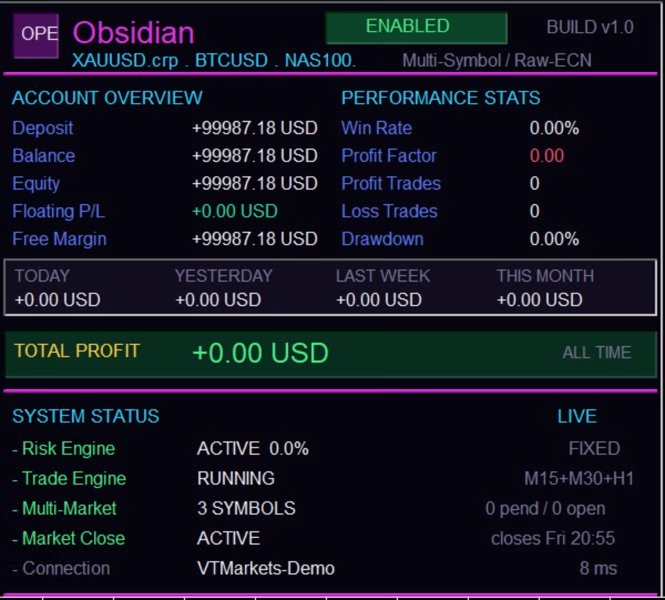
The EA is primarily optimized for XAUUSD on the M15 timeframe, while also supporting BTCUSD and NASDAQ as additional markets. Each supported symbol can be enabled or disabled independently, allowing traders to build a configuration that fits their trading environment.
Obsidian Pivot Engine is designed with a strong focus on structured execution, risk control, pending-order management, and continuous automated operation.
For the initial evaluation, the recommended configuration is simple:
- Symbol: XAUUSD
- Timeframe: M15
- Inputs: Default settings
- Account: Demo account
- VPS: Recommended for continuous operation
The internal methodology used to identify levels, filter signals, and manage entries is part of the proprietary design of Obsidian Pivot Engine.
Professional Breakout Trading for MT5
Obsidian Pivot Engine is built around the concept of identifying relevant market levels and looking for potential breakout opportunities.
Instead of relying on a single timeframe, the EA can analyze information from multiple timeframes to evaluate market structure and potential trading conditions.
When the strategy detects a valid setup according to its internal rules, it may use pending orders to participate in a potential breakout.
This approach is designed to provide structured and systematic execution without requiring the trader to manually monitor the market throughout the day.
Optimized for XAUUSD M15
The primary configuration of Obsidian Pivot Engine is focused on XAUUSD M15.
Gold is a highly active instrument where spreads, volatility, liquidity, execution speed, and market conditions can have a meaningful impact on automated breakout strategies.
For this reason, the recommended starting point is to use the EA exactly as configured:
XAUUSD + M15 + Default Parameters
Testing the default configuration also makes it easier to compare results across different brokers and trading accounts.
BTCUSD and NASDAQ are supported as additional markets and can be enabled independently.
Multi-Timeframe and Multi-Symbol Analysis
Obsidian Pivot Engine can work with multiple symbols and timeframes internally while operating from MetaTrader 5.
Supported markets include:
- XAUUSD
- BTCUSD
- NASDAQ
Each symbol has its own configurable trading parameters, allowing traders to control the behavior of the EA according to the characteristics of each market.
The multi-timeframe architecture allows the EA to use information beyond the chart timeframe when evaluating potential trading opportunities.
Automated Pending Order Execution
Breakout trading often requires precise execution around important price levels.
Obsidian Pivot Engine can use pending orders when the conditions defined by the strategy are met.
The EA includes controls for:
- Entry distance.
- Maximum spread.
- Slippage.
- Number of pending orders.
- Number of open positions.
- Duplicate order filtering.
- Pending-order expiration.
This allows the trading process to remain systematic and reduces the need for constant manual intervention.
Built-In Risk Management
Risk management is a core component of Obsidian Pivot Engine.
Every position opened by the EA includes a Stop Loss according to the configured protection logic.
Position size can be calculated automatically based on the selected risk settings, or traders can choose a fixed trading volume.
Automatic volume calculation can use either:
- Account balance.
- Account equity.
The EA also provides an aggregate risk limit per symbol. When the configured exposure reaches the defined percentage of account equity, the EA may prevent additional entries until the exposure returns within the permitted range.
Stop Loss and Position Protection
Obsidian Pivot Engine does not rely on Take Profit by default.
Instead, the EA uses Stop Loss and dynamic position management as part of its trading framework.
A trailing stop mechanism is also available to manage positions as market conditions develop.
When instrument or broker-server restrictions prevent the requested protection from being placed normally, the EA includes a fallback mechanism designed to continue managing position protection.
This is particularly important when trading instruments with different execution rules and minimum stop-distance requirements.
No Martingale, Grid or Loss Averaging
Obsidian Pivot Engine does not use:
- Martingale.
- Grid trading.
- Averaging losing positions.
- Automatic lot increases after a loss.
The absence of these mechanisms does not mean the EA is low-risk.
Automated trading remains exposed to market volatility, execution conditions, slippage, spreads, liquidity, and unexpected market movements.
Traders should always select their account size and risk settings according to their own financial situation and risk tolerance.
Advanced Order and Trade Management
The EA includes several mechanisms designed to maintain clean and controlled trade execution.
Key features include:
- Duplicate order filtering.
- Configurable maximum positions per symbol.
- Configurable pending-order limits.
- Automatic Friday pending-order expiration.
- Optional holiday position-closing protection.
- Price normalization for different execution conditions.
- Automatic risk-based position sizing.
- Fixed-volume trading option.
- Trailing Stop management.
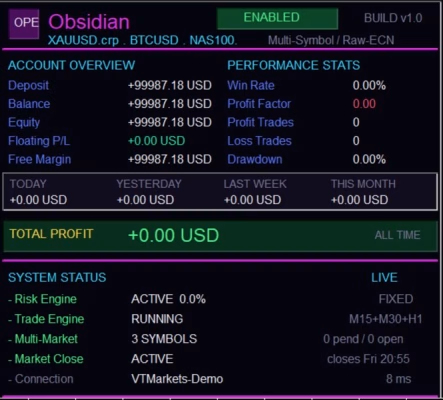
- On-screen information panel.
These features are designed to make the EA suitable for systematic automated trading on MetaTrader 5.
Broker and Execution Conditions Matter
Broker selection can have a significant impact on the performance of a breakout-based Expert Advisor.
Important factors include:
- Spread.
- Commission.
- Slippage.
- Latency.
- Liquidity.
- Execution speed.
- Minimum order distance.
- Trading-session restrictions.
- Instrument specifications.
The same EA can produce different results on different brokers because execution conditions are not identical.
For testing purposes, traders may research brokers such as VT Markets, Vantage, and FP Markets. These are simply examples for independent evaluation and are not presented as officially associated with Obsidian Pivot Engine.
Always verify the specific XAUUSD trading conditions available for your country, account type, and broker server.
VPS for Continuous Automated Trading
For continuous automated operation, a VPS is strongly recommended.
MetaTrader 5 needs to remain connected and running so the Expert Advisor can monitor the market, manage positions, and control pending orders.
A properly configured VPS can reduce interruptions caused by:
- Internet disconnections.
- Computer shutdowns.
- Power outages.
- Operating system updates.
- Accidental MT5 closure.
- Local network problems.
For best results, choose a VPS with stable connectivity and low latency to your broker’s trading server.
A VPS does not improve the profitability of a trading strategy. Its purpose is to provide a more reliable environment for continuous EA operation.
Recommended Account Type
A Hedging account is recommended when independent management of multiple positions on the same instrument is required.
MetaTrader 5 brokers may offer either Hedging or Netting account structures, and their behavior can differ significantly when multiple positions are involved.
Before installing the EA, traders should confirm that their account type and broker specifications are compatible with the intended trading configuration.
Backtesting with MetaTrader 5 Strategy Tester
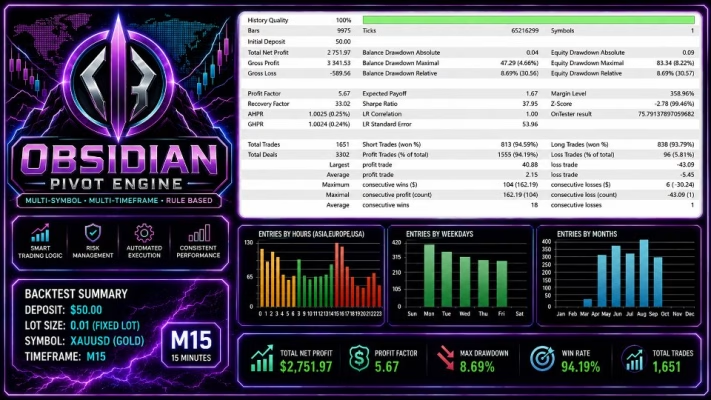
Obsidian Pivot Engine is compatible with the MetaTrader 5 Strategy Tester, allowing traders to evaluate the EA using historical market data before moving to live trading.
For more representative testing, consider:
- Using the highest-quality tick data available.
- Applying realistic spreads.
- Including realistic commissions.
- Considering reasonable execution conditions.
- Testing multiple historical periods.
- Avoiding conclusions based on a single optimized backtest.
Backtesting should be treated as a research and evaluation tool, not as a guarantee of future performance.
Live trading can produce different results because of spreads, slippage, latency, liquidity, broker execution, market conditions, and other factors.
Recommended Initial Configuration
For the first test, the recommended setup is:
Symbol: XAUUSD
Timeframe: M15
Parameters: Default values
Account: Demo
VPS: Recommended
It is recommended to avoid immediately changing multiple parameters.
Starting with the default configuration provides a more consistent reference point for evaluating EA behavior and comparing results across different brokers and accounts.
Once the initial testing phase is complete, experienced traders can experiment with the available parameters according to their own strategy and risk management preferences.
User feedback is an important part of improving Obsidian Pivot Engine.
Both positive and negative feedback is valuable.
If you test the EA and encounter an issue, providing detailed information can make technical investigation much more effective.
Useful information includes:
- Broker.
- Account type.
- Symbol.
- Timeframe.
- EA version.
- Configuration.
- Approximate account size and risk level.
- Panel screenshot.
- Error screenshot or message.
Constructive suggestions are also welcome.
Not every recommendation can be implemented, but useful ideas may be considered for future versions of the EA.
The objective is not simply to collect positive reviews. The goal is to use real user feedback to improve Obsidian Pivot Engine over time.
Risk Disclaimer
Obsidian Pivot Engine does not guarantee profits.
Trading XAUUSD, BTCUSD, NASDAQ, Forex, CFDs, and other leveraged financial instruments involves significant risk and may result in substantial financial losses.
No Expert Advisor can guarantee future performance.
Backtested and historical results do not guarantee future results. Actual trading performance may differ because of spreads, commissions, slippage, latency, liquidity, broker execution, market volatility, and other market conditions.
Always test the EA on a demo account before considering live deployment.
Never trade with money you cannot afford to lose.
The trader is solely responsible for selecting the broker, account type, position size, risk level, and trading configuration that are appropriate for their individual circumstances.
Related products


EXPERT ADVISOR


EXPERT ADVISOR

EXPERT ADVISOR


EXPERT ADVISOR


EXPERT ADVISOR


EXPERT ADVISOR

EXPERT ADVISOR
EXPERT ADVISOR